Doors & Windows

The companies that let a buyer configure and price a $40 lock have a clear next move: bring that experience to the $4,000 opening.

Live configurator
$0
Est. · unit
Style
Finish
Hardware
32
Sites scored
the largest vertical in the cohort
70/100
Top score
Schlage, Yale & Wayne Dalton
30/100
Median score
room to climb across the field
3
Sites at the top
hardware and garage doors lead the way
The Doors & Windows Field

Stack-ranked list of Doors & Windows by composite score

Channel enablement score Buyer assist score
Composite score
01 Allegion · Schlage
30 40
70
02 Wayne Dalton
40 30
70
03 Yale Commercial (ASSA ABLOY)
40 30
70
04 JELD-WEN
20 25
45
05 Overhead Door Corporation
20 25
45
06 ProVia
20 25
45
07 Dormakaba USA
25 15
40
Hardware (Schlage, Yale) and garage doors (Wayne Dalton) lead. Window and door makers bring deep spec content and a clear opportunity to add configured selling. Showing the top 7 of 32; the full roster is in the appendix.
Inside the Category Leader
Schlage Pacesetter · Composite 70 · Channel 30 / Buyer 40 schlage.com
dw-leader
70/100 composite

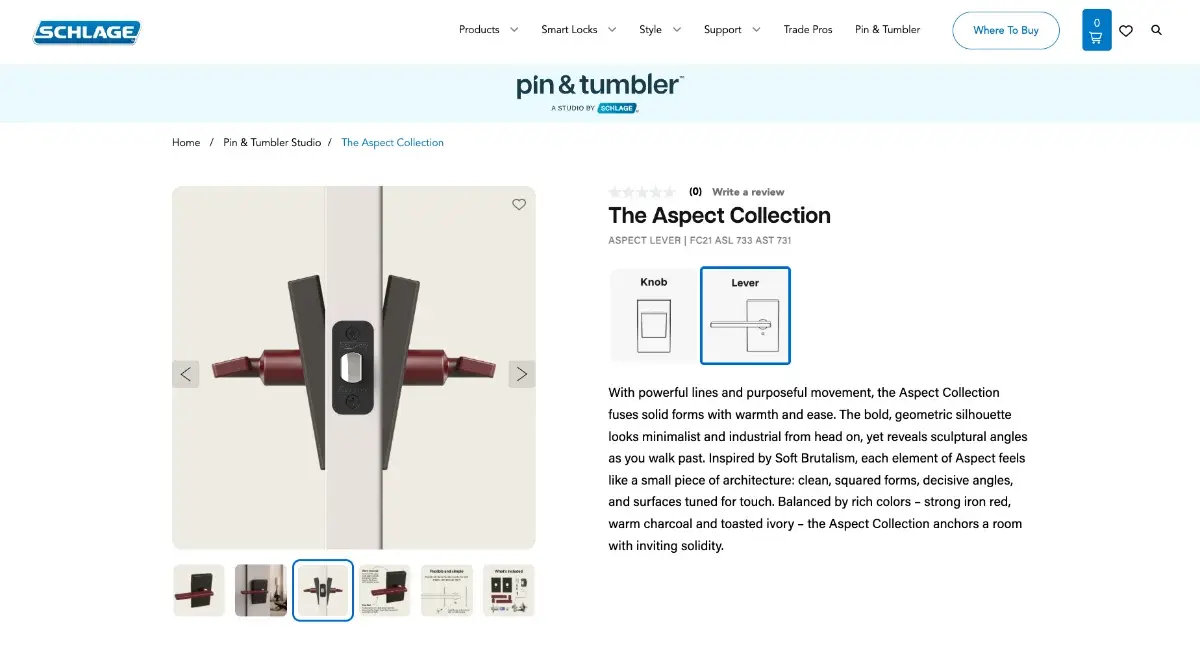
Schlage treats a lock as something a buyer can configure, price, and put in a cart — a model the rest of the vertical can build on.

  • Two named configurators live in the main nav. Pin & Tumbler Studio and Schlage Custom let a buyer build a finish-and-keyway combination visually.
  • Every variant shows a price. $20.99 to $329 on the product page — a self-serve number that qualifies the buyer before they ever reach a store.
  • Guided selling does the narrowing. A product finder plus combinable filtering walks a homeowner to the right lock, with a light AI layer that points to where the category is heading.
What to Notice · Configurator + Pricing
Configure it, see the price, add to cart. Pin & Tumbler Studio and Schlage Custom sit in the primary nav, every variant carries a price ($20.99–$329), and a guided finder narrows the catalog — a full buying flow on a hardware site.
What the Leaders Share

The three sites at the top run a complete selling flow, and their architectural lines hold the spec depth to extend it

Built the Tool, Skipped the Number
The telling pattern here is what the mid-table already owns. Makers like ProVia, Overhead Door, and Alside run a real product configurator and route it to nothing: no number, no quote, no configured handoff. They built the expensive tool and skipped the wiring. Connecting the configurator they already run to a dealer-routed, quotable lead is the highest-return move in the category, and it costs a fraction of what the configurator did. The architectural lines have the deep spec content; the wiring is what turns a high-consideration purchase into a qualified, dealer-routed lead.

Recommendations for Doors & Windows websites

01
Send the configured unit to the dealer
Carry the built spec, with size, finish, glass, and hardware, into the local dealer's hands.

Doors and windows install locally. When the configured unit arrives with the lead, the dealer quotes the real opening instead of restarting from a blank inquiry, and deep spec content finally connects to a sale instead of ending at a PDF.

02
Extend the configurator to the architectural line
Let a specifier or dealer build a door or window unit visually, the way Schlage builds a lock.

The configurator already runs on the consumer side of these same companies. Bringing it to the architectural opening is a feature release on content that is already built, not a project from scratch.

03
Publish installed-price ranges
Show “from $X” or configured guidance on windows and doors.

A homeowner replacing windows budgets in ranges before calling anyone. A range qualifies the lead and shortens the dealer's cycle on a purchase that otherwise starts with a cold quote request.

The hard part is done. These companies built a configurator good enough to sell a $40 lock; pointing the same tool at a $4,000 opening is a product decision, not an engineering project.

  • They sell direct on the consumer side. A configurator, guided finders, and a cart let a homeowner self-serve a lock from start to finish.

  • The spec depth is the channel’s foundation. The same companies’ architectural lines carry deep BIM and submittal content, ready to power a configured, dealer-routed opening.

How AI Transforms Selling · Doors & Windows

Five ways AI helps sell Doors & Windows

This is how Threekit's AI Sales Agent works: grounded in your catalog, configuration rules, knowledge base, and design content, and pointed at the way this vertical actually sells.

01
Start from anything
Upload speech, text, notes, pictures, or forms — or take a guided quiz.

A contractor uploads a photo of the existing opening and the jobsite measurement form; an architect pastes a spec section. A homeowner takes a quiz instead: replacement or new construction, climate, style.

02
Valid recommendations, explained
Recommends valid products and configurations, with explanations and confidence.

The agent recommends complete, valid units — size, glass, hardware that actually go together — explains egress and energy-code fit, and flags its confidence, so a first-timer and a specifier both get a defensible answer.

03
Change without starting over
Refine the build in plain language; the project keeps its state.

“Black exterior, tempered glass on the pair by the tub, keep everything else.” The whole opening schedule updates without re-entering a single unit.

04
Share and collaborate
Work the project with the channel and the end customer in one place.

The builder and the homeowner review the same opening schedule, and the dealer watches it settle before quoting. Nobody re-keys the order from an email thread.

05
Outputs that close
Produces proposals, quotes, and CPQ/ERP-ready outputs.

Quote-ready line items, submittal-style spec sheets, and a configured order the dealer’s CPQ and the manufacturer’s ERP can ingest directly. The $4,000 opening finally sells like the $40 lock.

From Threekit

Make it easier to sell

This index measured where the path to a sale breaks: the handoff that arrives blank, the configurator that never reaches a quote, the seller and the dealer working from different answers. Threekit's AI Sales Agent closes that gap. It takes your catalog, configuration rules, knowledge base, and design content and turns it into an expert seller that guides your reps, your channel, and your customers to the same right answer — configured, qualified, and routed with full context. Deploy on your website, in your channel portal, or with your reps.