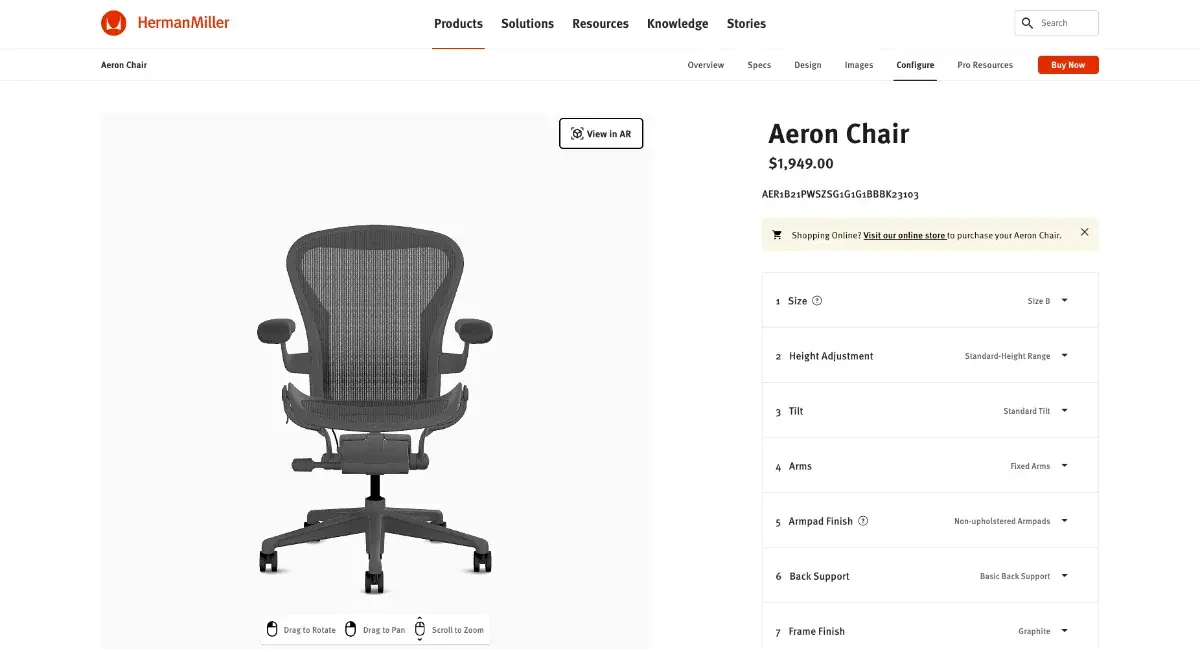
Herman Miller, KI, and OFS already put a real configurator in front of every visitor. Opening the existing tool captures the researcher ready to self-serve a $1,500 chair without touching the dealer who closes the larger project.
Contract Furniture
Built for designers for years. The leaders just opened that tooling to the buyer, too.
Stack-ranked list of Contract Furniture by composite score
Herman Miller gives a walk-in buyer the same tools it gives a design firm: a 3D configurator with a live price, on top of a full Revit library.
- The configurator carries a live price. 3D Cloud by Marxent gives spin-view, AR, and accurate pricing across 8+ chairs — a buyer configures an Aeron and sees the number.
- It serves the designer and the buyer at once. A full Revit/CAD/SIF spec library and published price books sit alongside a real e-commerce cart with combinable facets and save-to-wishlist.
- It still hands off cleanly. Configurations download and share to clients or dealers, so the trade relationship is reinforced, not bypassed.
The leaders open the trade’s own tooling so the dealer, the designer, and the buyer work from one site
Recommendations for Contract Furniture websites
Contract buyers and the designers serving them already work from list pricing. Publishing it, the way the leaders do, turns a trade portal into a buying tool without undercutting the dealer.
This is the rare vertical where the tooling is already paid for. The configurators and price books exist, behind a dealer login. The leaders just unlocked the door — it is a permissions change, not a build.
They serve the designer and the buyer at once. CAD and price books for the trade, a configurator and a cart for everyone else.
Opening the tooling is the move. The leaders put the configurator and the price in front of any visitor, not only a dealer login, on top of tooling the whole field already has.
Five ways AI helps sell Contract Furniture
This is how Threekit's AI Sales Agent works: grounded in your catalog, configuration rules, knowledge base, and design content, and pointed at the way this vertical actually sells.
A designer uploads the floor plan and finish schedule; an office manager describes headcount and growth and takes a short quiz. The agent turns either into a workable typicals plan.
It recommends valid workstation typicals — panels, surfaces, power, and storage that actually fit together — explains lead-time and finish-program fit, and scores confidence per option.
“Re-spec all 120 stations from fabric grade A to B and show the savings.” One instruction, the whole project updates, and the spec survives every value-engineering round.
The designer, the dealer, and the client review one living spec instead of versioned SIF files in email. The trade relationship is reinforced — everyone works the same project.
A priced proposal, spec output the dealer's tools can consume, and a CPQ/ERP-ready order. The walk-in buyer gets the Aeron; the dealer keeps the 400-seat project.
Make it easier to sell
This index measured where the path to a sale breaks: the handoff that arrives blank, the configurator that never reaches a quote, the seller and the dealer working from different answers. Threekit's AI Sales Agent closes that gap. It turns your catalog, configuration rules, and content into an expert seller that guides your reps, your channel, and your customers to the same right answer.